
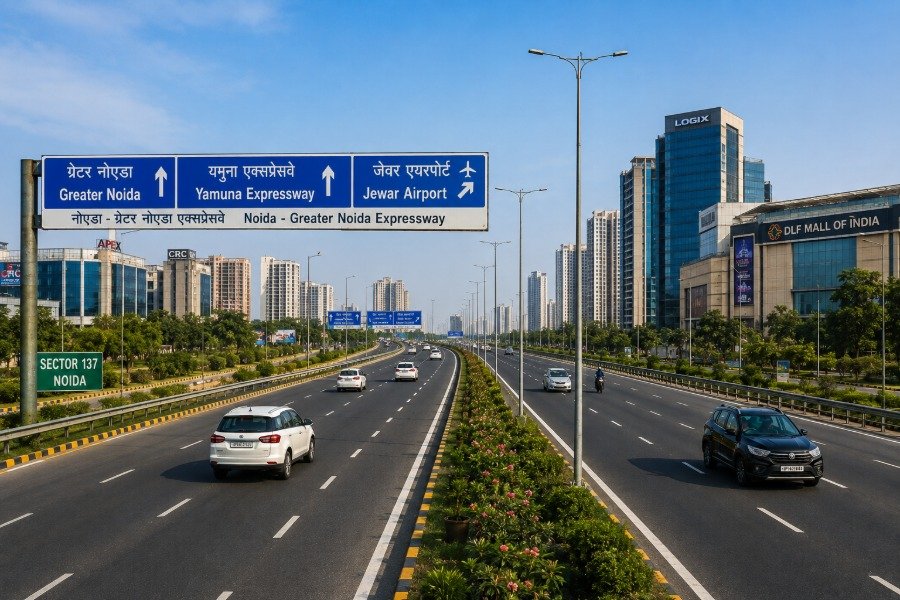
Noida Expressway
Noida Expressway – Route, Sectors, Attractions & Travel Guide
The Noida–Greater Noida Expressway is a major six-lane road corridor connecting Noida with Greater Noida in Uttar Pradesh. It begins near the Mahamaya Flyover in Noida and runs for about 24.5 km towards Pari Chowk in Greater Noida. Beyond transport, the corridor is known for major residential communities, IT and corporate offices, educational institutions, shopping destinations and access towards the Yamuna Expressway and Noida International Airport.
What is Noida Expressway?
The Noida–Greater Noida Expressway, commonly called Noida Expressway, is one of the principal road corridors of the National Capital Region. It links southern and central Noida with Greater Noida and provides onward connectivity towards the Yamuna Expressway.
The expressway is approximately 24.53 km long and has six lanes. Its northern end is around the Mahamaya Flyover in Noida, while the southern end reaches Pari Chowk in Greater Noida.
For travellers, the road is more than a commuter route. The corridor passes close to important destinations including Botanical Garden, Film City, Okhla Bird Sanctuary, Amity University, Noida Golf Course, major office districts and the wider Greater Noida commercial and institutional belt.
It is also increasingly important for airport travel. Noida International Airport at Jewar began commercial flight operations on 15 June 2026, while the airport is directly connected to the six-lane Yamuna Expressway.
Why Should You Travel Along Noida Expressway?
- Delhi-NCR connectivity: A direct road link between Noida and Greater Noida.
- Business travel: The corridor serves major corporate and IT developments.
- Education: Amity University and several educational institutions are located along or near the corridor.
- Shopping: Sector 18 and other commercial areas are accessible from the northern end.
- Nature: Okhla Bird Sanctuary and Botanical Garden are nearby.
- Family travel: Several entertainment and leisure destinations can be combined into a single itinerary.
- Airport transfers: The corridor connects into the wider road network leading towards the Yamuna Expressway and Noida International Airport.
- Photography: The urban skyline, landscaped medians and long road perspective offer interesting cityscape views.
- Road trips: The route provides a practical starting point for journeys towards Greater Noida, Agra and other destinations.
- Chauffeur travel: A private taxi is useful when travelling between multiple sectors, offices, hotels and attractions.
Where is Noida Expressway Located?
The Noida Expressway runs through Noida and Greater Noida in Gautam Buddh Nagar district, Uttar Pradesh. It begins around the Mahamaya Flyover and continues south towards Pari Chowk.
Quick Facts
| Travel Point | Information |
|---|---|
| Official route | Noida–Greater Noida Expressway |
| Approx. length | 24.5 km |
| Northern end | Mahamaya Flyover, Noida |
| Southern end | Pari Chowk, Greater Noida |
| State | Uttar Pradesh |
| Country | India |
| Main road connection | Yamuna Expressway |
| Major nearby hub | Sector 18, Noida |
| Airport connection | Noida International Airport via Yamuna Expressway |
| Metro | Aqua Line stations serve parts of the wider corridor |
There is no single metro station for the entire expressway because it passes through a long sequence of sectors. Botanical Garden is an important interchange at the northern end, while Aqua Line stations such as Sector 137, Sector 142 and Sector 143 provide access to different parts of the wider Noida Expressway corridor.
What are the Top Attractions Along Noida Expressway?
1. Botanical Garden
The Botanic Garden of Indian Republic in Sector 38A is close to the northern end of the corridor. It is known for specialist plant collections, green spaces and botanical research. Visitors should check current access conditions before travelling.
Best time: October–March
Recommended duration: 1.5–2.5 hours
2. Okhla Bird Sanctuary
Located near the Yamuna and Okhla Barrage, this protected wetland is one of Noida’s most distinctive natural attractions. Winter is particularly rewarding for birdwatching because of migratory species.
Best time: November–March
Recommended duration: 2–3 hours
3. Film City Noida
The established Film City in Sector 16A is associated with television, film production, broadcasting and media education. It is close to the northern approach to the expressway.
Best time: Daytime
Recommended duration: 30–60 minutes, subject to access
4. Noida Golf Course
Located near Sector 38, the golf course provides a green contrast to the surrounding commercial development. It is primarily a sporting facility rather than a conventional tourist attraction.
Best time: Morning
Recommended duration: Depends on access and activity
5. Amity University
The Amity University campus in Sector 125 is one of the major educational landmarks near the corridor. The surrounding area has also developed into an important education and business district.
Best time: Daytime
Recommended duration: Subject to appointment or access
6. Sector 18 & DLF Mall of India
The Sector 18 commercial district is easily accessible from the northern end of the expressway and offers extensive shopping, dining and entertainment.
Best time: Afternoon–evening
Recommended duration: 2–4 hours
7. Pari Chowk, Greater Noida
Pari Chowk marks the southern end of the Noida–Greater Noida Expressway and serves as an important junction for Greater Noida.
Best time: Daytime or evening
Recommended duration: 20–30 minutes as a stop
What are the Best Things to Do?
- Drive the Noida–Greater Noida Expressway as part of a wider NCR itinerary.
- Stop at Botanical Garden when visitor access is available.
- Visit Okhla Bird Sanctuary for winter birdwatching.
- Explore Film City from public areas or through an authorised appointment.
- Combine business travel with nearby shopping and dining.
- Visit Sector 18 and DLF Mall of India.
- Continue towards Pari Chowk and Greater Noida.
- Use the route as part of an onward journey towards the Yamuna Expressway.
- Book a chauffeur-driven car when multiple sectors need to be covered in one day.
When is the Best Time to Travel?
The road can be used throughout the year, but weather and traffic make a noticeable difference to the journey.
| Season | Conditions | Recommendation |
| Summer | Hot afternoons | Travel early morning or evening |
| Monsoon | Rain and occasional waterlogging | Allow extra travel time |
| Winter | Cooler and generally comfortable | Best for sightseeing |
For sightseeing rather than simply commuting, October to March is generally the most comfortable period.
Traffic conditions can change quickly around major junctions and commercial areas, so travellers should allow a buffer during weekday peak periods.
How Can You Reach Noida Expressway?
By Road: The expressway can be approached from Delhi through the DND Flyway, Mahamaya Flyover and other major Noida roads. It connects onwards to Greater Noida and the Yamuna Expressway.
By Metro: There is no single metro station serving the complete expressway. Botanical Garden is useful for the northern end, while the Aqua Line provides access to several sectors along the wider Noida Expressway corridor.
By Air: Travellers can use Noida International Airport (DXN), which commenced commercial operations in June 2026. The airport has direct connectivity with the six-lane Yamuna Expressway.
Indira Gandhi International Airport remains another major airport option for Delhi-NCR travellers.
By Train: New Delhi, Hazrat Nizamuddin and Anand Vihar are useful railway gateways, followed by metro or road travel into Noida.
By Taxi: A chauffeur-driven car is particularly convenient for travellers visiting several sectors or combining business appointments with sightseeing. India Taxi Online can be considered for airport transfers, local sightseeing, intercity journeys and chauffeur-driven car rentals.
Relevant services include Delhi Taxi Service, Tempo Traveller on Rent, Force Urbania on Rent and Outstation Taxi Service.
Travel Tips
- Plan the route by sector: The expressway is long enough that the nearest access point matters.
- Allow extra time during peak hours: Traffic can build around junctions and merging roads.
- Monsoon caution: Heavy rain can affect traffic around low-lying sections and nearby junctions.
- Do not stop on the main carriageway: Use designated parking or safe stopping areas.
- Fuel planning: Check your fuel level before starting a longer journey.
- Airport transfers: Confirm the correct airport before booking; Noida International Airport and IGI Airport are separate airports.
- Photography: Do not photograph while driving or stop in unsafe locations for pictures.
- Families: A private car is useful when travelling with children and luggage between multiple destinations.
- Navigation: Check live traffic conditions before departure.
- Night travel: Use caution, follow speed limits and avoid unnecessary roadside stops.
Frequently Asked Questions
What is Noida Expressway famous for?
Noida Expressway is famous for connecting Noida with Greater Noida while providing access to major residential, commercial, educational and institutional developments. It also connects towards the Yamuna Expressway, making it an important road for travellers continuing towards Greater Noida, Jewar and other destinations in western Uttar Pradesh.
How long is the Noida Greater Noida Expressway?
The Noida–Greater Noida Expressway is approximately 24.5 kilometres long. It runs from around the Mahamaya Flyover in Noida to Pari Chowk in Greater Noida and forms one of the principal road connections between the two cities.
Where does Noida Expressway start and end?
The expressway starts near the Mahamaya Flyover in Noida and continues southwards to Pari Chowk in Greater Noida. From the Greater Noida side, travellers can connect towards the Yamuna Expressway and onward destinations.
Which metro station is nearest to Noida Expressway?
There is no single nearest metro station because the expressway covers about 24.5 km. Botanical Garden is useful near the northern end, while the Aqua Line serves several sectors along the wider Noida Expressway corridor, including stations around Sectors 137, 142 and 143.
Is Noida Expressway connected to Yamuna Expressway?
Yes. The Noida–Greater Noida Expressway connects Greater Noida towards the Yamuna Expressway, creating an important road corridor between Noida, Greater Noida and destinations farther east and south. The network is particularly relevant for travellers heading towards Jewar and Noida International Airport.
How far is Noida Expressway from Delhi?
The distance depends on where you enter the corridor. The northern end is close to the Delhi border and can be reached from Delhi through routes including the DND Flyway. Travel time varies significantly according to the starting point, traffic and time of day.
Is Noida Expressway suitable for sightseeing?
The expressway itself is primarily a transport corridor, not a sightseeing attraction. However, several attractions are located nearby, including Botanical Garden, Okhla Bird Sanctuary, Film City, Sector 18 and other destinations. A planned taxi itinerary can combine several of these stops efficiently.
Which airport is closest to Noida Expressway?
There are two important airport options. Noida International Airport (DXN) is now operational and directly connected to the Yamuna Expressway, while Indira Gandhi International Airport (DEL) remains a major gateway for Delhi-NCR. The most convenient airport depends on your route and flight.
Can I hire a taxi for Noida Expressway travel?
Yes. A taxi is useful for airport transfers, corporate travel, sightseeing and journeys between Noida and Greater Noida. For groups, a Tempo Traveller or Force Urbania can be more practical than multiple cars, particularly when luggage and several stops are involved.
What is the best time to travel on Noida Expressway?
For comfortable sightseeing, October to March is generally preferable. For daily commuting, the best time depends on traffic rather than season. Early mornings and later evenings can be more comfortable in summer, while monsoon journeys should include additional time for weather-related delays.
