
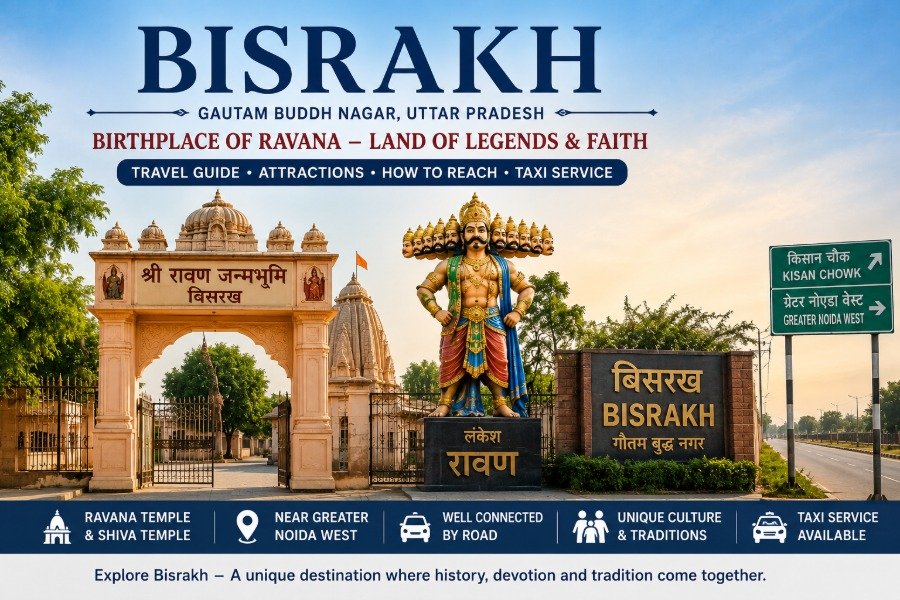
Bisrakh
Bisrakh Travel Guide: Ravana Temple, Things to Do, How to Reach and Taxi Service
Bisrakh is a historic village in Gautam Buddh Nagar, Uttar Pradesh, on the Greater Noida side of Delhi-NCR. It is best known for the local belief that Ravana was born here and for its ancient Shiva temple. The village is especially distinctive during Dussehra, when residents traditionally avoid Ravana Dahan and observe prayers instead.
What is Bisrakh?
Bisrakh, also known as Bisrakh Jalalpur, is a village in Gautam Buddh Nagar district near Greater Noida West. Although surrounded by the rapid development of the Greater Noida region, it retains a traditional village character and a strong religious identity.
Its principal attraction is the Shiva temple popularly associated with Ravana. According to local tradition, the village was connected with Rishi Vishrava, Ravana’s father, and is regarded by residents as Ravana’s birthplace. These are local religious and mythological traditions rather than independently established historical facts, making Bisrakh particularly interesting for travellers exploring India’s living traditions.
Why Should You Visit Bisrakh?
Bisrakh offers a very different experience from the modern malls, business districts and planned sectors of Greater Noida.
- Ravana and Ramayana traditions: Explore a place where Ravana is remembered through a local spiritual tradition.
- Shiva worship: The village’s temple is associated with an unusual Shiva lingam and the story of Rishi Vishrava.
- Unique Dussehra tradition: Unlike most of North India, Bisrakh is known for not following the conventional Ravana-burning tradition.
- Local culture: Walk through the village to see traditional neighbourhoods alongside modern Greater Noida West.
- Photography: Temple architecture, village lanes and religious details provide distinctive subjects.
- Families: A short cultural visit can be combined with attractions in Greater Noida.
- Spiritual travellers: The Shiva temple makes Bisrakh particularly relevant for devotees.
- History and mythology enthusiasts: The village offers an opportunity to understand how epic traditions remain part of contemporary community life.
Where is Bisrakh Located?
Bisrakh is situated in Gautam Buddh Nagar district, Uttar Pradesh, India, close to Greater Noida West and the Kisan Chowk area. It is approximately 30 km from central New Delhi by road, although actual journey times vary considerably with traffic and the starting point.
Quick Facts
| Travel Point | Information |
|---|---|
| State | Uttar Pradesh |
| District | Gautam Buddh Nagar |
| Region | Delhi-NCR |
| Nearby urban area | Greater Noida West |
| Nearest railway options | Ghaziabad / Dadri, depending on train and route |
| Metro access | Road transfer required |
| Major airport options | Noida International Airport or Delhi IGI |
| Best local transport | Private taxi or car |
Noida International Airport is now operational, with commercial passenger flights beginning in June 2026, providing a new aviation gateway for travellers visiting the wider Greater Noida region.
What are the Top Attractions in and Around Bisrakh?
1. Bisrakh Shiva Temple
The Shiva temple is the centrepiece of Bisrakh’s religious identity. Local tradition associates it with Rishi Vishrava and Ravana, and the temple’s Shiva lingam is considered especially significant by devotees.
Best time: Early morning or evening
Recommended duration: 45–60 minutes
2. Ravana Temple and Shrine
The temple complex is widely identified with Ravana worship. In recent years, the complex has also incorporated idols associated with Lord Ram, Sita and Lakshmana, adding another layer to its religious significance.
Best time: Morning
Recommended duration: 45–60 minutes
3. Bisrakh Village
The village itself is part of the experience. Its narrow lanes, older homes, temples and newer development reveal the contrast between traditional settlement patterns and Greater Noida’s expanding urban landscape.
Best time: Morning or late afternoon
Recommended duration: 45–90 minutes
4. Kisan Chowk
Kisan Chowk is an important nearby Greater Noida West landmark and a useful reference point when travelling towards Bisrakh. It also connects visitors with the rapidly developing commercial areas of Greater Noida West.
Best time: Daytime
Recommended duration: 30–45 minutes
5. Greater Noida West
Combine a Bisrakh visit with Greater Noida West for a broader look at the area’s modern residential development, restaurants, cafés and commercial centres.
Best time: Late afternoon or evening
Recommended duration: 2–3 hours
6. Surajpur Wetland
For travellers interested in nature, Surajpur Wetland can be added to a wider Gautam Buddh Nagar itinerary. It is known for wetland habitat and birdwatching, particularly during the winter migratory season.
Best time: November to March
Recommended duration: 2–3 hours
What are the Best Things to Do in Bisrakh?
- Visit the Shiva temple associated with Ravana’s local tradition.
- Observe the temple’s religious architecture and Shiva worship practices.
- Learn about the village’s unusual Dussehra customs.
- Explore Bisrakh’s traditional lanes respectfully.
- Photograph the village and temple surroundings.
- Combine Bisrakh with Greater Noida West sightseeing.
- Visit nearby Surajpur Wetland if you want to add nature and birdwatching.
- Taste local North Indian food at suitable nearby eateries.
When is the Best Time to Visit Bisrakh?
| Season | Weather & Experience | Recommendation |
| Summer | Hot afternoons and strong sunshine | Visit early morning |
| Monsoon | Greener surroundings but rain can disrupt plans | Good for short local visits |
| Winter | Cooler and more comfortable outdoors | Best overall season |
Winter is generally the easiest season for exploring Bisrakh on foot. If your interest is specifically the village’s Dussehra tradition, check the current year’s religious programme before travelling, as local observances can vary.
How Can You Reach Bisrakh?
By Air: Travellers can use Noida International Airport at Jewar or Indira Gandhi International Airport in Delhi. A pre-booked taxi is useful for the onward road journey.
By Train: Bisrakh does not have a major railway station within the village. Dadri and Ghaziabad provide practical rail options depending on the train and starting point, followed by a road transfer.
By Metro: There is no metro station inside Bisrakh. Travellers using the Noida Metro or Delhi Metro network need to complete the journey by road.
By Road: Bisrakh is accessible from Noida, Greater Noida, Ghaziabad and Delhi through the NCR road network.
By Taxi: For visitors combining Bisrakh with Greater Noida West, Surajpur or Noida, a private car is the most convenient option. India Taxi Online offers Outstation Taxi Service, airport transfers, Tempo Traveller rental and Force Urbania rental for larger groups.
Travel Tips for Bisrakh
- Dress respectfully when visiting the temple.
- Remove footwear where required and follow temple instructions.
- Ask permission before photographing worshippers or religious ceremonies.
- Avoid blocking narrow village lanes with a parked vehicle.
- Visit during daylight if exploring the village on foot.
- Carry drinking water during summer.
- Families travelling with elderly visitors should prefer a private car because walking surfaces and lanes can be uneven.
- During religious festivals, expect larger crowds and allow additional travel time.
- Treat the Ravana birthplace claim as a local belief and cultural tradition, rather than presenting it as proven historical fact.
- Combine Bisrakh with nearby Greater Noida attractions to make better use of a full day.
Frequently Asked Questions
What is Bisrakh famous for?
Bisrakh is best known for the local belief that Ravana, the king of Lanka in the Ramayana, was born in the village. It is also recognised for its Shiva temple and unusual Dussehra tradition, in which the community traditionally does not celebrate Ravana Dahan in the conventional manner.
Is Bisrakh really the birthplace of Ravana?
Bisrakh is traditionally regarded by local residents as Ravana’s birthplace, and this belief is central to the village’s identity. However, the claim belongs to religious and mythological tradition rather than established historical evidence. Travellers should understand it as an important element of local cultural heritage.
Why is Ravana worshipped in Bisrakh?
Local tradition considers Ravana an important figure connected with the village and remembers him not simply as the antagonist of the Ramayana, but also for his association with scholarship and devotion to Shiva. This explains why the community’s Dussehra observance differs from the widespread Ravana-burning tradition.
Does Bisrakh celebrate Dussehra?
Bisrakh is known for not following the conventional Dussehra practice of burning Ravana effigies. Local residents have traditionally observed the period with prayers and remembrance instead. Visitors planning a festival-day trip should check current local arrangements because religious practices and access can change.
What is the main temple in Bisrakh?
The principal religious attraction is the Shiva temple popularly associated with Ravana. Local tradition connects the temple with Rishi Vishrava and an ancient Shiva lingam. The site is therefore important both as a place of worship and as the centre of Bisrakh’s distinctive Ramayana-related identity.
Is Bisrakh suitable for families?
Yes. Bisrakh can work well as a short cultural and religious excursion for families, particularly when combined with nearby Greater Noida attractions. Parents should supervise children around crowded areas and respect temple rules. A private taxi is convenient for families carrying bags or travelling with elderly members.
How far is Bisrakh from Delhi?
Bisrakh is within the Delhi-NCR region and is roughly 30 km from central New Delhi by road, although the actual distance and journey time depend on the starting point and traffic. Travellers from Noida and Greater Noida generally have a shorter road journey.
Can I hire a taxi to Bisrakh?
Yes. A private taxi is one of the easiest ways to visit Bisrakh, especially if you want to combine the temple with Greater Noida West, Surajpur or Noida. A chauffeur-driven car also avoids the inconvenience of navigating narrow village roads and arranging separate local rides.
What is the best time to visit Bisrakh?
Winter and early mornings are generally the most comfortable. Summer afternoons can be very hot, while monsoon rain may make local roads less convenient. If the purpose of your trip is religious, festival dates such as Dussehra and Mahashivratri can be particularly meaningful, subject to current temple arrangements.
