
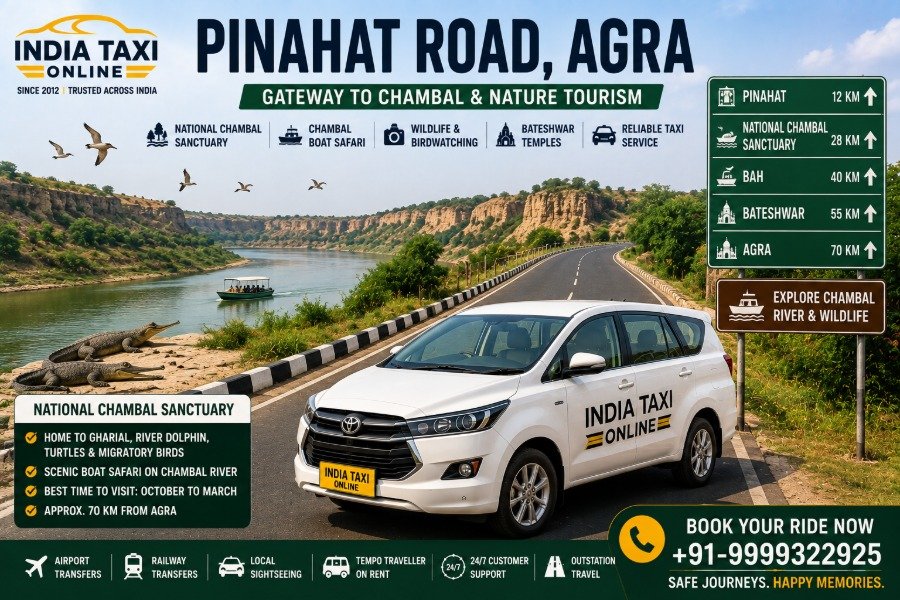
Pinahat Road
Pinahat Road, Agra – Travel Guide & Taxi Service
Pinahat Road is an important regional road corridor connecting Agra district with Pinahat, Bah and the Chambal region of Uttar Pradesh. The area is particularly useful for travellers planning a National Chambal Sanctuary trip, wildlife safari, Bateshwar visit, rural Agra tour or outstation journey.
Pinahat is also one of the recognised access points to the National Chambal Sanctuary, making this road especially relevant for nature lovers, photographers and travellers looking for an alternative experience beyond Agra’s famous Mughal monuments. UP Ecotourism lists Pinahat, Uttar Pradesh, as a location for the National Chambal Sanctuary and recommends winter as the best time to visit.
What is Pinahat Road, Agra?
Pinahat Road connects southern and eastern parts of Agra district with Pinahat and the Chambal River landscape. Unlike central Agra’s tourist corridors, this route provides access to rural landscapes, villages, riverine areas and wildlife destinations.
The most important attraction associated with the area is the National Chambal Sanctuary, a protected ecosystem spread across Uttar Pradesh, Madhya Pradesh and Rajasthan. It is known for endangered gharials, Ganges river dolphins, turtles and a wide range of resident and migratory birds.
For visitors travelling from Agra, a private taxi is particularly convenient because the sanctuary and nearby attractions are outside the main city centre.
Why Should You Travel on Pinahat Road?
- Gateway to Chambal: Convenient route towards the National Chambal Sanctuary.
- Wildlife tourism: Access to one of North India’s important river ecosystems.
- Chambal Safari: Boat and nature experiences can be arranged in the sanctuary region.
- Rural landscapes: Experience a quieter side of Agra district.
- Bateshwar access: Combine a Chambal trip with the historic Bateshwar temples.
- Photography: Excellent opportunities for wildlife, birds, river landscapes and ravines.
- Family road trips: Private cars provide comfortable door-to-door transportation.
- Agra connectivity: Travel between Pinahat and Agra by road.
- Outstation travel: Useful for journeys towards Bah, Dholpur and neighbouring regions.
- Nature tourism: A good alternative to conventional city sightseeing.
- Birdwatching: The Chambal ecosystem supports numerous resident and migratory birds.
- Taxi convenience: A pre-booked vehicle is recommended for remote sightseeing.
Where is Pinahat Road Located?
Pinahat Road is in Agra district, Uttar Pradesh, leading towards the Pinahat area and the Chambal region.
The National Chambal Sanctuary’s Uttar Pradesh access is associated with Pinahat. UP Ecotourism states that the sanctuary is approximately 70 km from Agra and is well connected by road.
Quick Facts
| Travel Point | Information |
|---|---|
| State | Uttar Pradesh |
| District | Agra |
| Road | Pinahat Road |
| Main destination | Pinahat |
| Major attraction | National Chambal Sanctuary |
| Nearest major city | Agra |
| Nearby town | Bah |
| River | Chambal |
| Nature tourism | Boat safari & birdwatching |
| Main transport | Private taxi / road |
| Best season | Winter |
| Ideal for | Wildlife, nature & road trips |
What are the Top Attractions Near Pinahat Road?
1. National Chambal Sanctuary
The National Chambal Sanctuary is the principal attraction around Pinahat. The sanctuary protects important species including the critically endangered gharial, endangered Ganges river dolphin and red-crowned roof turtle.
The landscape includes the Chambal River, sandy banks and dramatic ravines.
Best time: Winter
Recommended duration: Half day to full day
2. Chambal River
The Chambal River is the heart of the sanctuary. Its relatively clean waters provide habitat for gharials, crocodiles, turtles, dolphins and numerous birds.
Best time: Morning
Recommended duration: 2–3 hours
3. Chambal Boat Safari
A boat safari is one of the most memorable ways to explore the sanctuary. Visitors may encounter gharials basking on riverbanks and, with luck, Ganges river dolphins and a variety of waterbirds.
Best time: Morning
Recommended duration: 1.5–2 hours
4. Bateshwar Temples
Bateshwar is a major cultural and religious attraction in the wider Agra region. The complex is known for its temples and ghats along the Yamuna and can be combined with a Chambal excursion.
The Agra district administration lists Bateshwar approximately 80 km from the district headquarters and identifies it for its temples and annual animal fair.
Best time: Morning or late afternoon
Recommended duration: 1.5–2 hours
5. Agra Fort
Visitors travelling from Agra can combine a Pinahat/Chambal excursion with Agra Fort before or after their nature trip. Agra Fort is a UNESCO World Heritage Site and one of the city’s principal Mughal monuments.
Best time: Morning
Recommended duration: 1.5–2 hours
6. Taj Mahal
The Taj Mahal can be included in a longer Agra itinerary. For travellers staying in Agra, a private taxi makes it easier to combine the Taj Mahal with a separate Chambal day trip.
Best time: Sunrise
Recommended duration: 2–3 hours
7. Fatehpur Sikri
Fatehpur Sikri is another UNESCO World Heritage Site in Agra district and can be included in a longer multi-day itinerary.
Best time: Morning
Recommended duration: 2–3 hours
8. Keetham / Sur Sarovar
Travellers interested in birdwatching can combine the Chambal region with Sur Sarovar Bird Sanctuary and Keetham Lake, depending on their route and available time.
Best time: Winter
Recommended duration: 2–3 hours
What are the Best Things to Do on Pinahat Road?
- Take a road trip from Agra towards Pinahat.
- Visit the National Chambal Sanctuary.
- Enjoy a Chambal River boat safari.
- Look for gharials and river dolphins.
- Photograph migratory and resident birds.
- Explore the Chambal ravines and river landscape.
- Visit Bateshwar temples.
- Experience rural Agra district.
- Combine the trip with Agra’s Mughal monuments.
- Hire a private taxi for a complete Agra–Chambal itinerary.
Wildlife You May See Around Pinahat
The National Chambal Sanctuary is particularly famous for its aquatic wildlife.
Potential sightings include:
- Gharial
- Ganges river dolphin
- Mugger crocodile
- Red-crowned roof turtle
- Indian skimmer
- Migratory waterbirds
- Resident river birds
The sanctuary is recognised as an important habitat for endangered wildlife, while Incredible India notes more than 300 species of resident and migratory birds across the sanctuary.
Wildlife sightings are never guaranteed, and visitors should maintain a safe distance and follow local sanctuary regulations.
When is the Best Time to Visit Pinahat Road?
Winter is the best season for a Pinahat and Chambal trip. UP Ecotourism specifically recommends winter for the National Chambal Sanctuary, while its visitor information gives an ideal visiting period of 15 November to 15 June.
| Season | Conditions | Best For |
|---|---|---|
| Summer | Hot afternoons | Early morning safari |
| Monsoon | Green landscape | Scenic road trips |
| Winter | Cool and comfortable | Wildlife & birdwatching |
| Spring | Warm but pleasant | Nature photography |
For wildlife photography, early morning generally provides the most comfortable light and conditions.
How Can You Reach Pinahat Road?
By Air
Agra Airport is the nearest local airport for travellers arriving by air. Delhi IGI Airport is another option for visitors requiring a wider range of flights.
By Train
For travellers arriving by rail, Agra Cantt and Agra Fort are the principal convenient railway options before continuing towards Pinahat by road. UP Ecotourism lists both stations as the nearest railway options for the National Chambal Sanctuary.
By Road
Road travel is the most practical way to reach Pinahat and the Chambal Sanctuary.
UP Ecotourism states that the National Chambal Sanctuary is approximately 70 km from Agra and has road connectivity through the region.
By Taxi
A private taxi is strongly recommended for a Pinahat/Chambal trip because attractions are spread across rural areas and public transport may not provide convenient point-to-point access.
India Taxi Online can arrange:
- Agra to Pinahat taxi
- Agra to Chambal Safari taxi
- Pinahat local taxi
- Agra railway station pickup
- Agra airport transfer
- Agra sightseeing
- Agra–Bateshwar taxi
- Agra–Bah taxi
- Delhi–Agra–Chambal tours
- Outstation taxi
- Tempo Traveller
- Force Urbania
- Luxury car rental
Agra to Pinahat Taxi Service
A private taxi from Agra is one of the easiest ways to explore Pinahat and the Chambal region.
A chauffeur-driven car allows travellers to:
- Start from an Agra hotel early in the morning.
- Travel towards Pinahat.
- Visit the National Chambal Sanctuary.
- Enjoy a river safari where available.
- Explore the surrounding landscape.
- Visit Bateshwar if time permits.
- Return to Agra the same day.
For families and groups, larger vehicles such as Tempo Traveller or Force Urbania can provide additional space.
Pinahat Road Travel Tips
- Start early for a Chambal wildlife trip.
- Carry drinking water and sun protection.
- Wear comfortable outdoor clothing.
- Carry binoculars for birdwatching.
- Use a qualified local naturalist or authorised safari operator where required.
- Do not feed or approach wildlife.
- Maintain silence around nesting and wildlife areas.
- Follow all sanctuary boating and photography rules.
- Avoid littering.
- Carry sufficient cash for remote areas where digital connectivity may be limited.
- Confirm the exact safari/boating point before leaving Agra.
- Pre-book your taxi for early morning departures.
- Allow extra time for rural roads and traffic.
- For groups, book a suitable vehicle according to passenger and luggage requirements.
Frequently Asked Questions About Pinahat Road, Agra
What is Pinahat Road Agra famous for?
Pinahat Road is particularly useful for reaching Pinahat and the National Chambal Sanctuary. It is a gateway to wildlife, river safaris, birdwatching and the rural landscapes of the Chambal region.
How far is Pinahat from Agra?
UP Ecotourism states that the National Chambal Sanctuary is approximately 70 km from Agra. The exact distance to a particular Pinahat Road destination depends on the starting point and route.
What is there to see near Pinahat?
The National Chambal Sanctuary and Chambal River are the main attractions. Bateshwar temples, rural landscapes and wildlife-viewing opportunities can also be included in a longer itinerary.
Can I take a Chambal Safari from Pinahat?
Yes. Pinahat is recognised as one of the access points associated with the National Chambal Sanctuary. Safari and boating arrangements should be confirmed in advance with the relevant authorised operator or local forest authorities.
What animals can I see in the Chambal Sanctuary?
The sanctuary is famous for gharial, Ganges river dolphin, mugger crocodile and red-crowned roof turtle, along with numerous bird species.
What is the best time for a Pinahat Chambal Safari?
Winter is the preferred season, especially for comfortable weather and birdwatching. UP Ecotourism identifies winter as the best time to visit and gives an ideal visiting period from 15 November to 15 June.
Can I visit Pinahat and Agra in the same trip?
Yes. Travellers can combine a Chambal excursion with Agra’s principal monuments. A multi-day itinerary is preferable if you want to comfortably cover the Taj Mahal, Agra Fort, Bateshwar and the sanctuary.
Can I book a taxi from Agra to Pinahat?
Yes. India Taxi Online can arrange private taxis from Agra hotels, Agra Cantt, Agra Fort, Kheria Airport and other pickup locations to Pinahat and the Chambal region.
Is Pinahat suitable for families?
Yes, particularly for families interested in nature and wildlife. A private taxi provides a more comfortable option than relying on multiple local transport connections.
Can I book an outstation taxi from Pinahat Road?
Yes. Outstation taxi services can be arranged for destinations such as Agra, Delhi, Mathura, Vrindavan, Bharatpur, Dholpur, Gwalior and Jaipur, depending on the route and vehicle requirement.
Is Pinahat Road suitable for photography?
Yes. The route and surrounding Chambal landscape offer opportunities for wildlife photography, bird photography, river landscapes, ravines and rural-life photography.
