
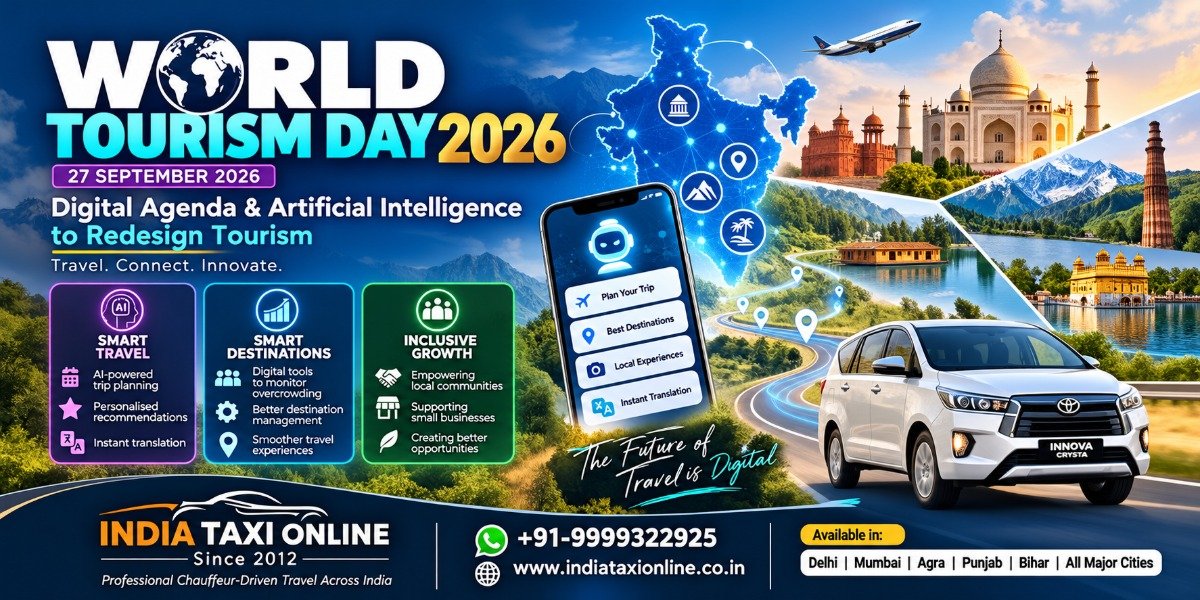
World Tourism Day 2026: How Digital Technology and Artificial Intelligence Are Redesigning Tourism
World Tourism Day 2026 will be observed on 27 September 2026 under the theme “Digital Agenda and Artificial Intelligence to Redesign Tourism.” The theme highlights a major transformation taking place across the travel industry as artificial intelligence, digital platforms, data and smart technologies change how people discover destinations, plan journeys, book transport and experience places.
UN Tourism selected this theme to explore how digital innovation and AI can reshape tourism while ensuring that technology remains inclusive and benefits travellers, tourism businesses, workers and local communities.
For India, where tourism ranges from heritage cities and pilgrimage centres to Himalayan destinations, beaches, wildlife reserves and rural communities, digital transformation presents significant opportunities.
What Is World Tourism Day 2026?
World Tourism Day is observed every year on 27 September to highlight the social, cultural and economic importance of tourism.
In 2026, the focus moves towards one of the most important technological developments affecting the travel industry: artificial intelligence.
The official 2026 theme, “Digital Agenda and Artificial Intelligence to Redesign Tourism,” reflects the growing role of technology in travel planning, destination management, tourism services and visitor experiences. UN Tourism’s 2026 programme also places emphasis on ensuring that technological development supports people and destinations rather than leaving communities behind.
How Is AI Changing the Way People Travel?
Artificial intelligence is already becoming part of the travel-planning process.
Instead of opening dozens of websites to research a destination, travellers can increasingly use AI-powered tools to organise information, compare options and create personalised itineraries.
AI can assist travellers with:
- Destination suggestions
- Personalised itineraries
- Route planning
- Hotel and transport research
- Restaurant and attraction recommendations
- Language translation
- Travel information
- Weather and journey planning
- Activity suggestions
- Real-time travel assistance
For example, a family travelling from Delhi to Agra, Mathura and Vrindavan could use an AI assistant to organise sightseeing based on available time, preferred attractions, age groups and transportation requirements.
The technology can reduce the amount of time spent searching for information while allowing travellers to focus more on the actual experience.
Smart Travel: Personalised Journeys Through AI
One of the most visible applications of artificial intelligence in tourism is personalised travel planning.
Traditional travel guides generally provide the same recommendations to everyone. AI can potentially adapt suggestions according to an individual’s preferences.
A traveller interested in history may receive an itinerary centred around monuments and museums. A family may prioritise comfortable transportation and child-friendly attractions. A spiritual traveller may focus on temples, pilgrimage sites and suitable travel timings.
This creates the possibility of moving from generic tourism recommendations towards more personalised journeys.
However, AI-generated recommendations should still be checked against official information, current operating conditions, opening hours, local regulations and professional travel advice.
AI and Instant Language Translation
Language can be a barrier for travellers visiting unfamiliar destinations.
AI-powered translation tools can help tourists understand signs, menus, directions and conversations in different languages.
This can be particularly useful in a country such as India, where dozens of languages are spoken across different regions.
Digital translation can help international visitors communicate more easily with drivers, hotels, restaurants, local guides and small businesses.
The result can be a more accessible travel experience, particularly when combined with human assistance.
How Can AI Improve Destination Management?
AI is not only changing the traveller’s experience. It can also help tourism authorities and businesses understand how destinations are being used.
Destination management involves managing visitor movement, infrastructure, attractions, transportation, resources and tourism services.
Digital systems can analyse information to identify patterns such as:
- High visitor volumes
- Peak travel periods
- Traffic congestion
- Demand for transportation
- Popular attractions
- Seasonal travel patterns
- Visitor preferences
This information can support better planning.
For example, if a particular attraction regularly experiences overcrowding during specific hours, digital information could help visitors consider alternative timings or nearby attractions.
The objective is not simply to move more tourists. It is to create a better balance between visitor demand, local infrastructure, environmental protection and community needs.
Why Inclusive Growth Matters in Digital Tourism
Technology can create new opportunities, but access to technology is not automatically equal.
Large hotel chains, online travel platforms and major tourism companies may have greater resources to invest in AI and digital systems than small operators.
World Tourism Day 2026 therefore also raises an important question:
How can digital tourism benefit small businesses and local communities?
Digital platforms can help local hotels, restaurants, guides, transport operators, artisans and experience providers become more visible to travellers.
A small homestay in a rural destination, for example, can use digital marketing and online booking technology to reach visitors who might previously never have discovered it.
UN Tourism’s rural tourism initiatives similarly emphasise digitalisation, connectivity, community participation and opportunities for local economic development.
India’s Digital Tourism Transformation
India is already developing a stronger digital ecosystem for tourism.
The Ministry of Tourism’s Incredible India Digital Platform provides travellers with information about destinations, attractions, itineraries and travel services. The platform also includes digital maps, multimedia content and booking-related services.
The Ministry has highlighted the use of an AI-powered tool designed to personalise visitor experiences, including real-time information and travel services.
This demonstrates how digital technology is becoming an important part of India’s tourism infrastructure.
For travellers, the transformation means that the journey increasingly begins online.
A visitor may discover a destination through digital content, research it using AI, create an itinerary, book accommodation and transportation online, navigate using digital maps and share the experience through social media.
AI Can Help Travellers Discover More of India
India has an enormous range of tourism experiences.
From the Taj Mahal and Delhi’s historic monuments to the Himalayas, Rajasthan’s forts, Kerala’s backwaters, Goa’s beaches, Northeast India, Buddhist destinations and major pilgrimage circuits, the country’s tourism offering extends far beyond its most famous cities.
AI-powered travel discovery could help visitors find destinations based on interests rather than simply popularity.
A traveller looking for mountain experiences might explore Himachal Pradesh, Uttarakhand or the Northeast.
Someone interested in spirituality could explore destinations such as Varanasi, Ayodhya, Haridwar, Rishikesh or major pilgrimage circuits.
A heritage enthusiast could create journeys covering Delhi, Agra, Jaipur and other historic cities.
This can potentially distribute tourism demand across a wider range of destinations.
Technology Should Support Human Travel Experiences
Despite the rapid development of artificial intelligence, tourism remains fundamentally human.
A digital itinerary can suggest a destination, but a local guide can explain its history.
An AI translation tool can translate a sentence, but a local resident can explain the culture behind it.
A navigation system can identify a route, while an experienced driver can provide practical local knowledge about road conditions, travel timings and stops.
This human element is particularly important for chauffeur-driven travel and road journeys.
Technology can make travel planning more efficient, but personal service continues to influence how visitors experience a destination.
The United Nations’ 2026 World Tourism Day message similarly stresses that technology should serve people and that tourism workers, communities and emerging destinations should have a role in shaping the digital future.
The Role of Digital Technology in Road Travel
Road transportation is another area where technology is changing tourism.
Travellers increasingly use digital tools to:
- Compare vehicle options
- Plan routes
- Estimate journey times
- Locate attractions
- Communicate with drivers
- Share live locations
- Manage bookings
- Access digital payment options
- Coordinate multi-city itineraries
For long-distance journeys, digital planning can help coordinate multiple destinations and travel requirements.
A professional chauffeur-driven taxi service can combine this technology with local knowledge, vehicle planning and customer support to create a smoother journey.
For travellers booking an outstation taxi, the important factors remain practical: vehicle condition, driver experience, route planning, transparent pricing, inclusions, travel distance and customer support.
Artificial Intelligence and Sustainable Tourism
Another important question is whether AI can contribute to more sustainable tourism.
Digital systems can help destinations understand visitor flows and resource requirements.
Better information can support:
- Traffic management
- Visitor distribution
- Efficient transportation planning
- Resource management
- Destination monitoring
- Promotion of alternative destinations
- Better planning during peak seasons
UN Tourism’s work on rural destinations also connects digitalisation with sustainability, community participation, infrastructure and responsible tourism development.
However, technology itself is not automatically sustainable. Its benefits depend on how it is designed and used.
What Does World Tourism Day 2026 Mean for Travellers?
For travellers, the 2026 theme represents a shift towards a more connected travel experience.
The future journey may look like this:
Discover → Ask AI → Personalise → Book → Navigate → Experience → Share
A traveller could begin by asking an AI assistant for destination ideas, refine the itinerary according to budget and interests, book hotels and transportation, use digital maps during the journey and receive real-time information while travelling.
But technology should remain a tool rather than replacing personal judgement.
Travellers should verify important information, especially regarding prices, entry requirements, weather, road conditions, accommodation policies, attraction timings and local regulations.
What Does the AI Future Mean for Tourism Businesses?
Travel businesses also need to adapt to changing consumer behaviour.
Tourists increasingly expect information to be:
- Fast
- Accurate
- Easy to understand
- Mobile-friendly
- Available online
- Personalised
- Accessible across different languages
For taxi operators, hotels, tour operators and travel agencies, this means maintaining accurate digital information is becoming increasingly important.
Vehicle details, service areas, contact information, routes, pricing policies and booking procedures should be clearly communicated online.
AI can assist businesses with customer service, content creation, itinerary planning, data analysis and operational workflows, while human teams remain responsible for service quality and important decisions.
India Taxi Online: Connecting Technology With Human Travel
At India Taxi Online, digital technology and professional travel services come together to make road travel easier for customers.
Since 2012, India Taxi Online has provided taxi and chauffeur-driven travel services for customers travelling across Delhi, Mumbai, Agra, Punjab, Bihar and other major cities and destinations.
From local sightseeing and airport transfers to outstation journeys, multi-city tours and group transportation, digital communication helps travellers enquire, plan and coordinate their journeys more conveniently.
The future of tourism will continue to combine technology with human service.
AI can help a traveller plan the route. Digital tools can simplify communication. Navigation technology can assist the journey.
But the actual travel experience still depends on reliable vehicles, experienced drivers, local knowledge and customer service.
World Tourism Day 2026: The Future of Travel Is Human and Digital
World Tourism Day 2026 highlights an important transition in the travel industry.
“Digital Agenda and Artificial Intelligence to Redesign Tourism” is not simply a technology-focused theme. It raises broader questions about how tourism should evolve and who should benefit from digital transformation.
AI can make travel planning faster and more personalised.
Digital platforms can improve access to tourism information.
Smart destination management can help authorities respond to visitor pressures.
Technology can give small tourism businesses new ways to reach customers.
At the same time, responsible digital tourism requires attention to accessibility, digital skills, privacy, sustainability, human employment and community participation.
The future of travel will not be defined by artificial intelligence alone.
It will be shaped by how travellers, businesses, communities and destinations use technology.
On 27 September 2026, World Tourism Day provides an opportunity to celebrate tourism while looking ahead to a new generation of smarter, more connected and more inclusive travel.
Travel smarter. Explore further. Experience more.
About India Taxi Online
India Taxi Online – Since 2012 provides chauffeur-driven taxi and car rental services for local and outstation travel.
Service Areas: Delhi | Mumbai | Agra | Punjab | Bihar | All Major Cities
WhatsApp: +91-9999322925
Website: www.indiataxionline.co.in
